
Play safe · By JoinTheSwing editorial · Last reviewed September 28, 2026
Condom size chart: how to find a condom that fits
Condom size is mostly about width, not length. The number that matters is the nominal width: the condom’s flat width in millimetres, half its unstretched circumference, as the WHO/UNFPA condom specification (opens in a new tab) defines it. Standard condoms are about 52 to 53 mm. The specification defines no “large” size, and larger condoms run 56 mm or more. Measure your erect girth, then adjust by feel.
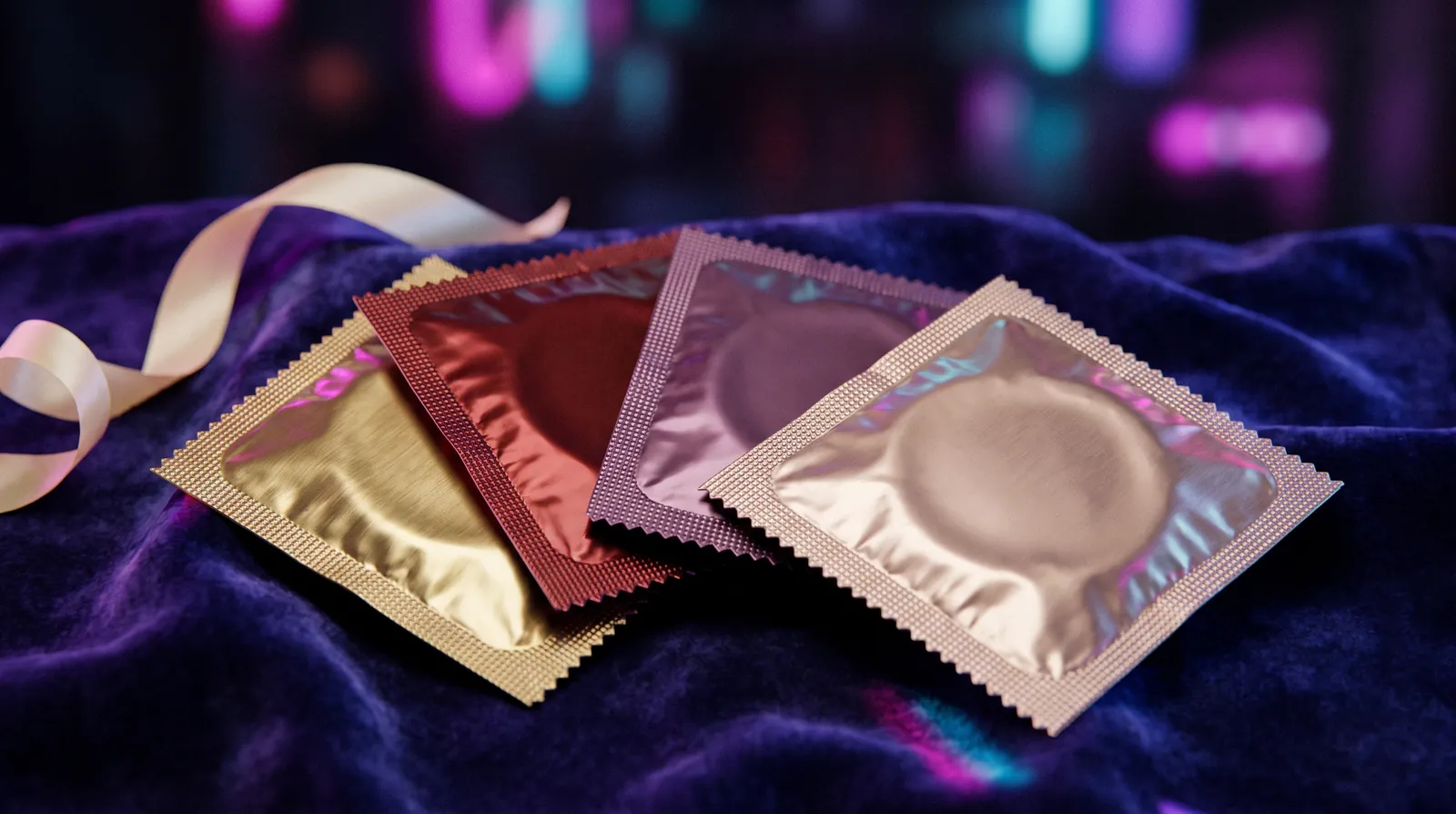
Why fit matters
Why fit matters for protection.
Condoms work very well when they are used correctly every time, and fit is part of using them correctly. The WHO/UNFPA condom specification (opens in a new tab), the standard that public health programmes buy condoms against, notes that condoms much too large or too small for the wearer appear to fail more often. Cleveland Clinic’s medically reviewed condom guide (2025) (opens in a new tab) lists a poor fit among the everyday reasons condoms fail, alongside too little lube and expired condoms.
The research points the same way. In a study of 436 men, Crosby and colleagues (2010) (opens in a new tab) found that the 44.7% who said their condoms fitted poorly had about two and a half times the odds of reporting breakage and of slippage, and were more likely to take the condom off before sex had ended. In a 2008 study of 820 men, Reece and colleagues (opens in a new tab) compared standard condoms with condoms sized to each man’s measurements: the fitted condoms broke less often (0.7% against 1.4%), most clearly for men with larger dimensions, although they slipped more for some men. Fit helps; it does not replace putting the condom on correctly.
The reassuring part: most people fit most condoms. A Cleveland Clinic urologist (2023) (opens in a new tab) says standard sizes are right for the vast majority. A too-big condom can slip off and a too-small one can break, so the goal is simply to rule out a bad fit.
What the numbers mean
Nominal width is what the sizes really mean.
Words like “snug”, “regular” and “large” are marketing labels. The measurement behind them is the nominal width: the width of the condom laid flat, in millimetres. Because a flat tube has two layers, the width is half the condom’s circumference before it stretches, as the WHO/UNFPA specification (opens in a new tab) defines it.
The same specification describes three widths that it says meet the needs of most people: a narrower condom of about 49 mm, which many manufacturers make; a standard condom, usually 52 to 53 mm; and larger condoms, for which there is no recognised size, though some manufacturers make condoms of 56 mm or more. Individual condoms may vary by about 2 mm either way from the width on the label.
That lack of a standard for large sizes is why brand labels do not line up: one brand’s large can be close to another’s standard. Go by the millimetre width printed on the box or the manufacturer’s own size chart, not the word on the front. We do not list brand dimensions here, because they change and should come from the manufacturer.
Measure at home
How to measure your girth in two minutes.
The measuring method follows Cleveland Clinic's guidance: measure a fully erect penis with a flexible tape, and take girth around the widest part of the shaft. The conversion and halving steps are simple arithmetic.
Step 01
Measure when fully erect, in private.
Condom sizes are based on an erect penis, so a flaccid measurement will mislead you. Pick a private moment; nobody else needs to be involved or to see the number.
Step 02
Wrap a soft tape around the thickest part.
Girth is the distance around the widest part of the shaft. Use a flexible sewing tape, snug but not tight. No tape? Wrap a strip of paper or a piece of string, mark where it meets, then lay it flat against a ruler.
Step 03
Write it down in millimetres.
Condom widths are printed in millimetres. If you measured in inches, multiply by 25.4: a 4.5-inch girth is about 114 mm, a 5-inch girth about 127 mm.
Step 04
Halve it to compare with the box.
Half your girth is the flat width of a condom that would sit around you with no stretch at all. Condoms are made to stretch (Cleveland Clinic, 2023), so the one that fits is narrower than that. For example, the average erect girth of 11.66 cm (Veale et al., 2015) halves to about 58 mm. Our reading is that a 52 to 53 mm standard is the usual fit for that, and Cleveland Clinic (2023) says standard sizes are right for the vast majority.
Step 05
Start with standard, then adjust by feel.
Most people fit a standard condom. Use the chart below as a starting point, then trust how it feels: move narrower if it slips or bunches, wider if it pinches or will not unroll to the base.
Size chart
A condom width chart by fit.
| Fit | Nominal width | In inches | Unstretched circumference | Try it if |
|---|---|---|---|---|
| Snug (narrow) | About 49 mm | 1.93 in | About 98 mm (3.9 in) | Standard condoms slip, bunch at the base or feel loose |
| Standard (regular) | 52 to 53 mm | 2.05 to 2.09 in | 104 to 106 mm (4.1 to 4.2 in) | You have no complaints; the starting point for most people |
| Large (wide) | 56 mm or more | 2.20 in or more | 112 mm or more (4.4 in or more) | Standard condoms feel uncomfortably tight, will not unroll to the base, or break |
For context, the average erect girth in the clinician-measured review by Veale and colleagues (2015) (opens in a new tab) was 11.66 cm (about 4.6 inches). Half of that is about 58 mm, and a 52 to 53 mm standard condom stretches around it. That arithmetic is ours, and it lines up with Cleveland Clinic’s advice (2023) that standard sizes are right for the vast majority. That is why standard is the right first try for most people, and why narrower and wider options exist for the people either side of the middle.
Too tight or too loose
Signs a condom is too tight or too loose.
A well-fitted condom covers the penis snugly, but not too tightly, from tip to base, with about half an inch of space at the tip. A little rolled-up condom left at the base is fine. These are the signs to change size, from Cleveland Clinic’s troubleshooting chart (2023) (opens in a new tab):
Probably too small or too narrow
- It will not unroll all the way to the base.
- It leaves no room for the reservoir at the tip.
- It feels uncomfortably tight or pinches.
- It breaks.
Probably too big or too wide
- It slips during sex or comes off when you pull out.
- There is a lot of rolled-up condom left at the base.
- You feel much less than you expect.
Not every break is about size. Cleveland Clinic’s condom guide (2025) (opens in a new tab) also lists too little lube, wearing two condoms at once, expired condoms, and nails, jewellery or piercings that nick the material. The NHS (2024) (opens in a new tab) adds a simple rule: one condom at a time, a new one every time.
Length
Length is rarely the problem.
People worry about length, but condoms are long. The WHO/UNFPA specification (opens in a new tab) sets minimum lengths of 165 mm for condoms narrower than 50 mm, 180 mm for 50 to 55.5 mm, and 190 mm for 56 mm and wider: about 6.5, 7.1 and 7.5 inches. In the United States, the FDA minimum for external condoms is 160 mm, according to Cleveland Clinic (2023) (opens in a new tab). The average erect length in the Veale review (opens in a new tab) was 13.12 cm, so most people have condom to spare, and a little left rolled at the base is normal.
If a condom will not reach the base, that is the sign to go up a size. Because larger condoms are also wider, girth is still the better guide. More on the averages, and how little they matter to partners, is in our guide to average penis size.
Latex and non-latex
Latex and non-latex: what changes.
Latex is the most common condom material. For anyone with a latex allergy, or a partner with one, condoms made of polyurethane, polyisoprene or nitrile are a good alternative and help prevent both pregnancy and STIs, according to Cleveland Clinic (2025) (opens in a new tab). The NHS (opens in a new tab) also advises against latex while using antifungal medicine on or around the genitals.
Natural-skin condoms, often called lambskin, are different. They help prevent pregnancy, but they have tiny pores that bacteria and viruses can pass through, so healthcare providers do not recommend them for STI prevention (Cleveland Clinic, 2025). For playing safe with new partners, choose latex or one of the synthetic materials.
Different materials feel different, so if you switch material, check the fit again rather than assuming the same width feels the same. Cleveland Clinic (2023) (opens in a new tab) suggests trying a few kinds: several may fit, and one will usually feel best.
Lube
Which lube works with which condom.
Lube lowers friction, and friction is one of the things that tears condoms, so a little extra is good for comfort and protection. The one rule to remember: oil and latex do not mix. The CDC (2024) (opens in a new tab) warns that oil-based products such as baby oil, lotion, petroleum jelly or cooking oil will cause a condom to break.
| Condom material | Water-based | Silicone-based | Oil-based |
|---|---|---|---|
| Latex | Yes | Yes | No: can make it break |
| Polyisoprene | Yes | Yes | No: can make it break |
| Polyurethane or nitrile | Yes | Yes | Yes |
| Natural skin (lambskin) | Yes | Yes | Yes, but not for STI protection |
The CDC (opens in a new tab) also advises against condoms or lubes containing nonoxynol-9, a spermicide, because it can cause irritation.
More than one partner
A fresh condom for every partner, and a few sizes on hand.
In the lifestyle, where you may meet more than one person in an evening, the basics matter more, not less. Cleveland Clinic’s condom guide (2025) (opens in a new tab) names using the same condom with more than one partner during group sex as a cause of condom failure, and the CDC (opens in a new tab) says never to reuse one. A new condom for each partner, every time, is the rule.

- Bring your own supply in your size. Some hosts and venues put out supplies, but you cannot count on your size being there.
- If you are a couple, or you are unsure of your fit, keep a couple of widths in your bag.
- Carry them in a case or a bag pocket, not a wallet: the CDC says heat and friction in a wallet can damage condoms.
- Check the use-by date. Expired condoms are more likely to break, and depending on material they last one to five years (Cleveland Clinic, 2025). In the UK, look for the CE or UKCA mark (NHS).
- If a condom feels sticky, dry or stiff when you open it, throw it away and use another (Cleveland Clinic, 2025).
Identity verification on any platform, including JoinTheSwing when it opens, confirms who someone is. It does not verify sexual health or consent. Talk about protection and testing before anything happens, and see our play-safe guide for the other layers: testing, barriers for oral sex, and vaccines.
Common questions
Condom size questions, answered plainly.
What size condom do I need?
Measure your erect girth, the distance around the thickest part of the shaft, with a soft tape. Most people fit a standard condom, which the WHO/UNFPA condom specification puts at a nominal width of about 52 to 53 mm. If a standard condom feels tight or will not unroll to the base, try a wider one of about 56 mm or more; if it slips or bunches, try a narrower one of about 49 mm.
What size condom fits a 6-inch penis?
Length alone does not decide it. A 6-inch (15.2 cm) erect length fits inside standard condoms, because the WHO/UNFPA specification sets minimum lengths of 165 to 190 mm (about 6.5 to 7.5 inches) depending on width. What decides your size is girth, so measure around the shaft and choose the width from that.
Is 5 inches small for condoms?
No. Five inches (12.7 cm) is close to the average erect length of 13.12 cm reported by Veale et al. (2015), and length is rarely what makes a condom fit badly. If standard condoms slip or leave a lot of rolled material at the base, a narrower width of about 49 mm may fit better.
Do I need a large condom if I am 6 inches long?
Probably not, unless your girth calls for it. Large condoms are mainly wider, and the WHO/UNFPA specification notes there is no recognised standard for larger sizes, so one brand's large can be close to another's standard. Try a large (about 56 mm or wider) if standard condoms feel uncomfortably tight, will not reach the base or break.
What condom fits a 4.5-inch girth?
A girth of 4.5 inches (114 mm) is close to the average erect girth of 4.59 inches (11.66 cm) in Veale et al. (2015), so a standard condom of about 52 to 53 mm nominal width is the usual starting point. Adjust by feel: narrower if it slips, wider if it pinches or will not unroll.
What lube can I use with condoms?
Water-based and silicone-based lubricants are safe with every condom material. Oil-based products such as baby oil, lotion or petroleum jelly can make latex and polyisoprene condoms break (CDC, 2024; Cleveland Clinic, 2025); polyurethane and nitrile condoms tolerate oil.
Does condom size affect breakage?
It can. In a study of 436 men (Crosby and colleagues, 2010), those who said their condoms fitted poorly had about two and a half times the odds of reporting breakage and of slippage, and were more likely to take the condom off early. A 2008 study of 820 men (Reece and colleagues) found fewer breaks with condoms fitted to each man's measurements: 0.7%, against 1.4% for standard condoms.
Sources
Where every number on this page comes from.
Every figure above was checked against these sources on September 28, 2026. Inch conversions and circumferences are our arithmetic from the published widths.
WHO / UNFPA, 2010, revised 2013
Width is the lay-flat width, half the circumference; standard widths 49 mm and 53 mm (±2 mm), with the standard usually 52 to 53 mm and no recognised size for larger condoms (some makers produce 56 mm or more); minimum lengths 165, 180 and 190 mm by width; condoms much too large or small for the wearer appear to fail more often.
Cleveland Clinic, January 19, 2023
Condom Size Chart: Does Size Matter?
Most condoms fit most people; measure a fully erect penis with a flexible tape, length from the base to the tip and girth around the widest part of the shaft; too big can slip off, too small can break; the FDA minimum length is 160 mm; the fit and comfort troubleshooting chart.
Cleveland Clinic, medically reviewed, updated November 18, 2025
Condoms: Types, How To Use, Effectiveness & Risks
Lubricant rules by material; poor fit, too little lube, two condoms at once, expired condoms and sharing one condom between partners during group sex as causes of failure; natural-skin condoms are not recommended for STI prevention; shelf life of one to five years, and a condom that feels sticky, dry or stiff should be replaced.
Crosby et al., Sexually Transmitted Infections, 2010
Does it fit okay? Problems with condom use as a function of self-reported poor fit
436 men; the 44.7% who reported ill-fitting condoms had higher adjusted odds of breakage (2.6) and slippage (2.7), and of removing the condom before sex ended (2.0).
Reece et al., Sexually Transmitted Infections, 2008
Breakage, slippage and acceptability outcomes of a condom fitted to penile dimensions
Crossover study of 820 men: fitted condoms broke less often than standard ones (0.7% vs 1.4%), with the clearest benefit for larger dimensions; fitted condoms slipped more for some men.
Veale et al., BJU International, 2015
Clinician-measured averages: erect length 13.12 cm (SD 1.66, n = 692), erect circumference 11.66 cm (SD 1.10, n = 381), flaccid length 9.16 cm, stretched length 13.24 cm, flaccid circumference 9.31 cm; few erect measurements were taken in a clinic.
NHS, reviewed January 26, 2024
Use a new condom every time; condoms can also be used on sex toys; check the use-by date and the CE or UKCA mark; never use two at once; no oil-based lubricant with latex; skip latex with a latex allergy or while using antifungal medicine on the genitals; get help promptly if a condom splits or comes off.
CDC, April 3, 2024
Do not store condoms in a wallet; avoid nonoxynol-9; oil-based products such as baby oil, lotion and petroleum jelly make condoms break; never reuse a condom or use two at once.
CDC, December 2, 2024
If a condom breaks, PEP to prevent HIV must be started within 72 hours; talk to a provider, urgent care or an emergency room right away.
Where JoinTheSwing fits
A planned community built on consent and clear conversations.
JoinTheSwing is opening soon in 2026; registration opens once our safety and compliance checks are complete. Until then, the public guides are free to read, and the launch list is the only thing we ask for.
- What JoinTheSwing is
A planned, verification-first community for couples and singles in the lifestyle, opening in 2026. Public guides like this one are free to read now.
- What verification does not tell you
Identity verification confirms who someone is. It does not verify sexual health or consent, so bring your own protection and talk before anything happens.
- Events
JoinTheSwing does not host events or supply condoms or testing. Hosts and venues set their own rules; check them before you go.
Related answers
Opening soon in 2026
Get on the list.
We're opening in 2026 — join the list to hear first. Leave one email for approved registration information and occasional useful updates — no account, no card, no spam.
We do not sell your email. Service providers process it as described in our Privacy Policy. 18+ only.