
Play safe · JoinTheSwing editorial · Last reviewed September 28, 2026
Dental dams: the simple barrier for safer oral sex.
A dental dam is a thin, flexible square of latex or polyurethane laid over the vulva or anus during oral sex. It puts a barrier between mouth and skin, which lowers the chance of passing on STIs such as herpes and HPV. Use a new one every time, hold it gently, and a cut-open condom works in a pinch.

What a dental dam is
What a dental dam is, in plain terms.
A dental dam is a thin, flexible sheet, usually square, made of latex, polyurethane, nitrile or neoprene (Planned Parenthood, 2025 (opens in a new tab)). The name comes from dentistry, where similar sheets are used during dental procedures (Halifax Sexual Health Centre (opens in a new tab)). For sex, it is laid over the vulva or anus during oral sex so there is a barrier between one partner’s mouth and the other’s skin and fluids (CDC, 2024 (opens in a new tab)).
They are simple: no sizing, no fitting and nothing to put on in advance. Planned Parenthood lists them with condoms, internal condoms and latex or nitrile gloves as the barriers that make sex safer (Planned Parenthood (opens in a new tab)).
Dams are for anyone. They are used for oral sex on a vulva or on an anus, by people of every gender and orientation, in couples and in groups. If you have only ever used condoms, think of a dam as the matching tool for the kinds of oral sex a condom cannot cover.
What it protects against
What a dental dam protects against, and its limits.
Oral sex is much lower risk than vaginal or anal sex for HIV in particular, but that is not true of everything. The CDC says many STIs are spread through oral sex, and lists chlamydia, gonorrhea, syphilis, herpes, HPV and HIV among them; it puts the risk of getting or transmitting HIV from oral sex at little to none, and much lower than from anal or vaginal sex, and says that may not be true for other STIs (CDC, 2024 (opens in a new tab)). Cleveland Clinic says dental dams reduce the risk of STIs such as oral HPV (Cleveland Clinic, 2025 (opens in a new tab)).
Two honest limits. First, a dam covers only the skin under it, so anything outside its edges is not protected. Second, barriers lower risk without removing it; the CDC says correct condom use reduces the risk of disease but does not eliminate it, and the same logic applies to dams (CDC, 2024 (opens in a new tab)). None of the health sources we checked gives a percentage for how much dental dams reduce risk, so we do not give one.
The reassuring part: the CDC says STIs are very common, all are treatable with medicine and all are preventable, so regular testing is a normal part of sexual health (CDC (opens in a new tab)). A dam is one simple layer; testing is another. Our oral sex and STIs answer and the play safe guide put the layers together.
How to use one
How to use a dental dam, step by step.
It takes seconds once you have done it once. These steps follow the CDC and Planned Parenthood.
Step 01
Check the date and look it over.
Check the expiry date on the packet. Throw away any dam that is expired, torn, sticky, dried out or discolored, and make sure there are no holes or defects.
Step 02
Open it carefully.
Open the packet gently with your fingers and take the dam out carefully so you do not tear it.
Step 03
Add lube to one side, if you like.
A little water-based or silicone-based lube on the side that will touch your partner's skin can feel better, help the dam stay in place and make it less likely to tear. Never oil-based products.
Step 04
Place it before any contact.
Lay the dam flat over the vulva or anus before any mouth-to-skin contact starts, and keep it there until you finish. Remember which side faces your partner.
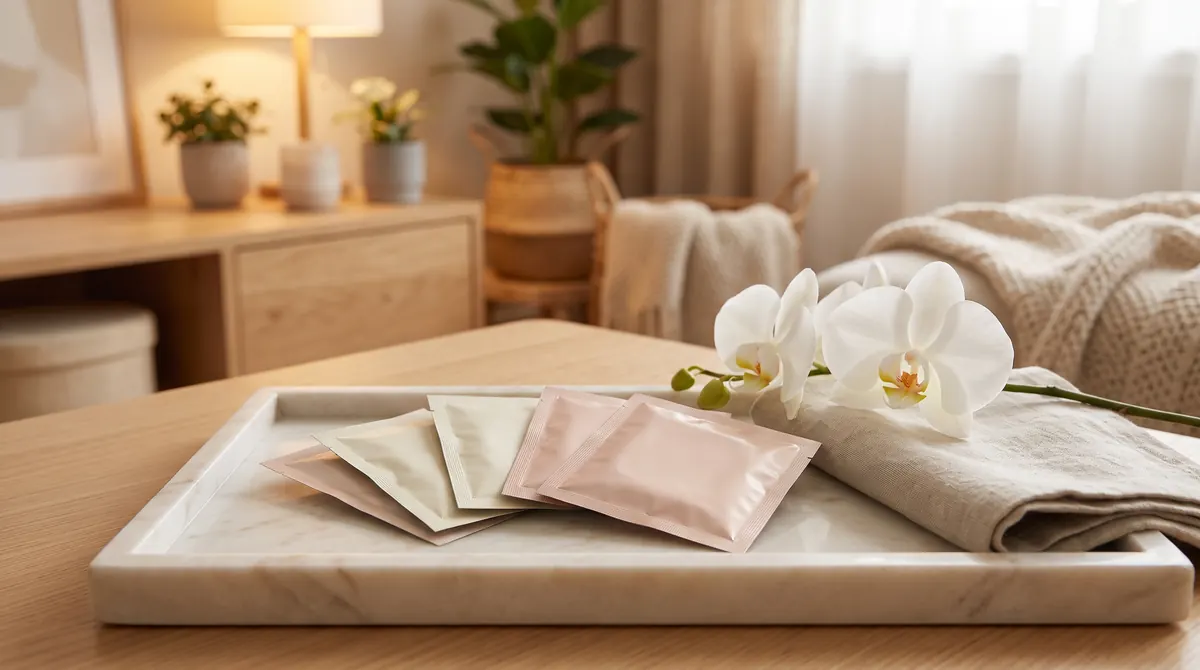
Illustrative scene, not JoinTheSwing members or an advertised event. Step 05
Hold it gently. Do not stretch it.
You do not need to stretch the dam or press it tight for it to work; stretching can tear it. Either partner can hold the edges in place.
Step 06
Use it once, then throw it away.
Never flip it over to use the other side, and never reuse it. Put it in the trash, not the toilet. For more oral sex, or a different partner, use a new dam.
Sources for the steps: CDC, 2024 (opens in a new tab); Planned Parenthood, 2025 (opens in a new tab). Planned Parenthood’s advice is to use a dam every time you have oral sex, placed before there is any mouth-to-skin contact (Planned Parenthood, 2025 (opens in a new tab)).
If a dam feels awkward at first, familiarity helps. Open one on your own first so you know how the material feels and which way it unfolds. Before anything starts, keep a couple within reach alongside the lube, so nobody has to go looking. Say what you are doing in a word or two; holding the edges can be something you do together rather than a pause.
Alternatives
No dam to hand? Two alternatives sexual health services describe.
Dental dams can be hard to find in shops. Both of these are described by sexual health services.
01
A condom, cut open
Condoms are easier to find than dams. Unroll a latex or polyurethane condom, cut off the tip and the base, then cut down one side so it opens into a flat rectangle. Use it exactly like a dam.
02
A glove, cut open
Cut the four fingers off a latex or plastic glove, keeping the thumb, then cut up the side opposite the thumb so the glove opens flat. Take care not to nick it anywhere else. A nitrile glove avoids latex altogether.
03
Gloves and finger cots, for hands
Not a dam alternative, but part of the same kit: a latex or nitrile glove, or a finger cot, keeps fluids off fingers during manual play.
The condom method comes from the CDC and Planned Parenthood; the CDC adds that the condom should be latex or polyurethane (CDC, 2024 (opens in a new tab); Planned Parenthood, 2025 (opens in a new tab)). The glove method is described by the Halifax Sexual Health Centre (Halifax Sexual Health Centre (opens in a new tab)). Gloves and finger cots for hands appear in Planned Parenthood’s and Cleveland Clinic’s safer-sex guidance (Planned Parenthood (opens in a new tab); Cleveland Clinic, 2025 (opens in a new tab)).
A cut-open condom or glove is used exactly like a dam: one side only, once, then in the trash. Stick to products made for the body, in the materials above. If you are not sure whether something improvised will protect you, a sexual health clinic can tell you, and some hand out dams or condoms.
Lube and comfort
Lube, allergies and comfort.
- Water-based or silicone-based lube only. Put it on the side of the dam that touches your partner. Lube can help sex feel better, keep the dam in place and stop it breaking (Planned Parenthood, 2025 (opens in a new tab)).
- No oil-based products. Baby oil, lotion, petroleum jelly and cooking oils can make dental dams break (Planned Parenthood, 2025 (opens in a new tab); CDC, 2024 (opens in a new tab)).
- No nonoxynol-9. The CDC advises against this spermicide with dams because it can cause irritation (CDC, 2024 (opens in a new tab)).
- Latex allergy? Choose a polyurethane or nitrile dam, or cut open a latex-free condom or a nitrile glove. Our non-latex guide covers the signs of a latex allergy and the materials.
Dams come in several materials and flavors (Halifax Sexual Health Centre (opens in a new tab)). Which you choose is a matter of taste; the same rules about lube, one side and one use apply to all of them.
Storage and buying
Storing and buying dental dams.
Store dams somewhere cool and dry, away from direct sunlight and sharp objects, which helps them last longer (Planned Parenthood, 2025 (opens in a new tab); CDC, 2024 (opens in a new tab)). Check the expiry date before use.
Dams can be hard to find in ordinary shops. Planned Parenthood suggests ordering online or trying a sex shop, and says some Planned Parenthood health centers have them, so call ahead (Planned Parenthood, 2025 (opens in a new tab)). The CDC notes ready-to-use dams can be bought online (CDC, 2024 (opens in a new tab)). If you cannot find any, condoms are sold almost everywhere and can be cut open as described above.
At events
Dental dams at lifestyle events: supplies and etiquette.
Most lifestyle events are social: mixers, dinners, dance nights and resort weekends where nobody is obliged to do anything. At the events where people do play, barriers are a normal part of the evening, and a few habits keep things easy.
- Bring your own. Some hosts put out supplies, but do not count on dams being among them, and your own are the ones you know are in date.
- Agree before, not during. Saying what protection you use for oral sex is part of the conversation about what you are both comfortable with, and a partner's answer is theirs to give.
- One dam per partner, per act. A new dam every time, and never passed from one person to the next.
- Keep it discreet. Used dams go in the trash, wrapped in a tissue if one is handy, the same way you would handle a condom.
- “No” needs no explanation. If someone does not want oral sex, with or without a dam, that is the whole answer, and leaving an event is always fine.
Our answers on consent in the lifestyle, words for saying no and how events handle safety go further.
Common questions
Dental dam questions, answered plainly.
What is a dental dam?
A dental dam is a thin, flexible square of latex, polyurethane or another synthetic material that you lay over the vulva or anus during oral sex. It puts a barrier between mouth and skin, which lowers the chance of passing on an STI. It is held gently in place, not stretched.
Do dental dams prevent STIs?
They lower the risk; nothing removes it entirely. The CDC says many STIs and other infections spread through oral sex, and lists chlamydia, gonorrhea, syphilis, herpes, HPV and HIV among them, with the risk of getting HIV from oral sex much lower than from anal or vaginal sex, which the CDC says may not be true for the others (CDC, About STI Risk and Oral Sex, 2024). A new dam for every act reduces contact with skin and fluids. None of the health sources we checked gives a percentage for how much a dam reduces risk, so we do not give one.
Can you use a condom as a dental dam?
Yes. The CDC describes cutting a condom open into a flat sheet: unroll it, cut off the tip and the base, then cut down one side, and make sure the condom is latex or polyurethane. Planned Parenthood describes its own version, cutting straight down the side with clean scissors. Use a new one each time.
Can you make a dental dam from a glove?
Yes. The Halifax Sexual Health Centre describes cutting the fingers off a latex or plastic glove, keeping the thumb, then cutting up the side opposite the thumb so it opens flat, and it warns not to puncture the glove anywhere else. Nitrile gloves are another latex-free option: Planned Parenthood lists latex or nitrile gloves among the barriers that make sex safer.
Can you reuse a dental dam or flip it over?
No. Planned Parenthood says never to turn one over and use the other side, because that side has already touched skin and fluids, and the CDC says to use a new dam every time rather than reusing one. Put it in the trash when you are done, not down the toilet.
What lube can you use with a dental dam?
Water-based or silicone-based lube, on the side that touches your partner's skin. Planned Parenthood says lube can help it stay in place and stop it breaking. Oil-based products such as baby oil, lotion or petroleum jelly can make a dam break, and the CDC advises against the spermicide nonoxynol-9 because it can cause irritation.
Editorial methodology
Sources for this guide
Every medical claim above is linked to one of these sources where it appears. Each source was opened and read on September 28, 2026. This page is written by JoinTheSwing editorial; it has not been reviewed by a named clinician.
Sources checked September 28, 2026
Planned Parenthood · 2025
What's a dental dam?
What a dental dam is and its materials; place it before any mouth-to-skin contact; hold, don't stretch; lube on the skin side; never flip or reuse; storage; where to buy.
CDC · 2024
How to use a dental dam
Latex or polyurethane dams; a new dam every time; no stretching; water- or silicone-based lube; no oil or nonoxynol-9; making a dam from a latex or polyurethane condom.
Planned Parenthood · 2025
How do you turn a condom into a dental dam for oral sex?
Step-by-step: turning a condom into a dental dam with clean scissors.
CDC · reviewed February 6, 2024
STI risk and oral sex
Many STIs and other infections spread through oral sex: chlamydia, gonorrhoea, syphilis, herpes, HPV and HIV; the risk of getting or transmitting HIV from oral sex is little to none and much lower than from anal or vaginal sex, which may not be true for other STIs; a barrier every time; anilingus can transmit hepatitis A and B.
Halifax Sexual Health Centre
Dental dams
Making a dental dam from a latex or plastic glove; cover the whole area; a new dam for every act.
Planned Parenthood
How do I have safer sex?
Barriers include condoms, internal condoms, dental dams and latex or nitrile gloves; sharing sex toys can pass fluids.
Cleveland Clinic · updated 2025
Condoms: types, use, effectiveness and how they work
Dental dams are thin latex or polyurethane sheets that reduce the risk of STIs such as oral HPV; finger condoms for hands.
CDC · 2024
Condom use: an overview
Condoms reduce the risk of disease but do not eliminate it; dental dams appear among the barriers that offer protection.
CDC
About STIs
STIs are very common, all are preventable and all are treatable with medicine, some curable entirely; testing matters if you are having sex.
Where JoinTheSwing fits
A planned community where your health stays your business.
JoinTheSwing is a verification-first lifestyle community opening soon in 2026; registration opens once our safety and compliance checks are complete. Our public guides are here now so couples and singles can arrive informed.
When JoinTheSwing opens, identity verification will confirm that a member is who they say they are. It does not verify sexual health, test results or consent. Those stay conversations between partners, ideally with dated test results shared between you, and JoinTheSwing never asks you to share them with us.
Opening soon in 2026
Get on the list.
We're opening in 2026 — join the list to hear first. Leave one email for approved registration information and occasional useful updates — no account, no card, no spam.
We do not sell your email. Service providers process it as described in our Privacy Policy. 18+ only.